|
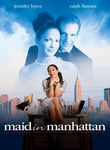
Maid in Manhattan Is Cinderella in New York? Yes, she is now a maid
named Marisa played by Jennifer Lopez and her prince is a
politician, Chris played by Ralph Kiennes. I had misgivings
about this film, but was surprised and pleased by the
snappy dialog, the supporting cast and the addition of a
ten-year-old boy. I dont have to protect or defend the
plot. You already know it. As you might expect, this film
is a romantic comedy, its well done and it is definitely
light entertainment. The character,
Marissa has a real mother, not a stepmother and her
competition instead of being stepsisters, is Caroline
played by Natasha Richardson, an English actress I have not
seen before. Lopez began her TV/film career in 1990,
although it really launched with Selena (1997), a story of the
slain Latino vocalist. As a vocalist herself, she has cut
three music albums; the first one went six times platinum.
Lopez is the first Latino actress to have a lead role in a
major Hollywood film since Rita Hayworth. A bit of trivia:
Lopez hired her ex-husband to run a restaurant she opened
in Pasadena called Madre. I also
saw Lopez in The Cell
(2000) and opposite George Clooney
in Out of Sight (1998) an Elmore Leonard story. I missed
Angel Eyes (2001)
but it is clear that Lopez has grown as an actress. Her
performance in this film was quite good; much enhanced by
the chemistry with Fiennes. Ralph
Fiennes has not been in a lot of films during his
twelve-year career. I was impressed with his work in
The English Patient (1996) and The End of the
Affair (1999). He seems to lean
toward the romance genre. The other
fact that made this film good was the support provided by
Stanley Tucci as Jerry the harried political aide, Bob
Hoskins as Lionel the hotels head butler, Marissa Matrone
as Marisas best friend, Stephanie and of course Tyler Posey
as Ty, Marisas son. After watching
this, I began thinking about the Cinderella fairy tale, a
story we take for granted but seem to enjoy again and
again. Why is this true? It is a rags to riches theme, but
I think there is more going on. The original written
version, Cendrillon, was included in Mother Goose stories
in French by Charles Perrault (1697). Since then there have
been hundreds of retellings and versions.
I believe the key element is a class
crossing relationship that provides the possibility for
genetic diversity in progeny. Folk tales were passed down
through generations as part of our oral literature prior to
written works. For children these tales were a means to
teach. One of the lessons probably recognized anecdotally
was the negative effect of inbreeding among the upper
classes. A way out of this bind would be to cross the class
boundary and produce children with the lower classes, e.g.
Cinderella or Eliza Dolittle. A
secondary, but still important, element is the patriarchal
structure of the solution, i.e. its always a prince in the
tale who finds the poor, needy, beautiful lower class girl
- saving her from a life of toil. Then in America, the story fits nicely into the upside
down snobbery of the class clash in a democracy rags to
riches again the little guy (gal) makes it big the American
dream. Whats the bottom line? This
is an upbeat Cinderella re-tell with good acting thats fun
to watch. And listen while you watch to hear Norah Jones
sing Come Away with Me
and Dont Know
Why. Reviewed March 26, 2003
|
 Maid in Manhattan