 Lagaan (subtitles)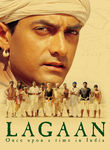
| reviewed by Chuck Markee |
[more] [back] |
by Chuck Markee
| reviewed by Chuck Markee | [more] [back] |
|
Lagaan (subtitles) This is a film that deserves the adjective, extravaganza. Its good entertainment that contains every possible dramatic emotional story element I can think of, courage, charisma, arrogance, love, spiritualism, repression, cruelty, domination, jealousy, racism need I go on? Maybe I should. Ill keep trying. Heres a summary. Its a historical fairy tale musical sports melodrama about a peasant super-hero. Do you understand this yet? Lets try comparisons. Its a combination of A League of their Own (1992), West Side Story (1961), The Magnificent Seven (1960), The Jackie Robinson Story (1950) and The King and I (1956, 1999). Im sure I left some out but thats the best I can do. If its not enough, I guess youll just have to watch it yourself. I guarantee, regardless of individual film watching penchants, there will be something in this film for everyone. The time portrayed is 1893 and the venue is a small village in India, called Champaner. It is under the protection of the local Raja, but under the heavy hand of the local British Cantonment. The film title, lagaan means land tax and its this tax, levied by the British, which establishes the conflict that drives the story forward. An important part of the climax and the resolution to the story line involves a cricket game and what a game that is! Aamir Kahn produced the film and also plays the lead role, a charismatic, peasant hero named Bhuvan. Kahn began his career in 1970 with a film success at the age of five. He quit films, become a state tennis champion, eloped at age 21 in the face of family opposition and was back in films by the time he was 23. He is now a well-known and successful Indian actor in many film genres, comedy, action, drama and romance and he was one of the three Khans that ruled Bollywood in the 1990s. What I saw of him in this film is a directors dream; handsome, an athlete, a dancer, a singer and a very versatile actor. Gracy Singh plays his love interest, Gauri. Shes a beautiful young woman, and her dance and vocal scenes are outstanding but she really shines because of her amazingly expressive face. Its almost as though the words appear on her forehead, jealousy, love, frustration, or anger. This was only her second film role. The support cast of villagers is a wonderful hodgepodge of characters, eleven of whom make up the cricket team. Theres a strong man, a sling sharpshooter, a crippled untouchable, and the list goes on. Rajesh Vivek plays my favorite village character, Guran, a wild man with an incredible shock of black hair and black beard and maniacal eyes. Paul Blackthorne plays Captain Andrew Russell, a character you will absolutely detest. He literally drips contempt with every word he speaks in this role. He reminds me of an attractive version of oil can Harry on the melodrama stage collecting the rent from the fair young virgin. His previous experience was only one TV series and one film role. Rachel Shelley plays Elizabeth Russell, the captains beautiful sister, visiting from England. She not only shifts her loyalty, causing some plot complexity, but she also enables a love triangle. Her career began in 1994 and has continued in both TV and film since then. Its the dramatic presentation of this film that makes it special, not the story line, although the story does follow a progression of plot points, the kind which make every tale of a heros journey successful. The archetypal characters are so clearly defined in the plot that they are almost icons. In fact, the one-dimensional simplicity of each character tends to focus emphasis on the story flow and its presentation rather than the story content. There is no complex undercurrent or psychological tangle in this plot. I also particularly liked the way the song and dance scenes were integrated seamlessly into the story line. The staging did not feel forced at all and the lyrics react to the emotional conditions rather than tell them. I was initially bothered by the electronic enhancement of the vocals but the voices were so lovely that I just accepted this as part of the performance after the first song. The God Krishna and his consort, Radha represent the films spiritual component. Krishna is the most widely revered and the most popular of all the East Indian deities. He symbolizes the divine and Radha the human soul. Much of Indias artistic activity over the centuries can be attributed to Krishna so his role in the storyline seems pertinent. One of the most emotional ceremonial performances in the film seeks his intercession. Radha is Krishnas mistress, yet she is married to someone else and this relationship is mimicked in the storyline love triangle. They are the metaphor for each other. The last part of the film involves a game of cricket, although it is not necessary to understand the game before you watch the film. In fact, you can learn quite a lot about cricket by just watching the two sides play in the film. However I found it a tad more interesting to know some of the play and scoring details, so Ive pasted a brief explanation below, in case anyone is interested. Be prepared for a long film, just short of four hours. The DVD has an intermission. It also has some outtakes that were easy decisions to remove. They would have destroyed character consistency. There was a previous film version of Lagaan done in 1971, but I couldn't find much information about it. Reviewed May 21, 2003Explanation of the game Cricket from the Encyclopedia BritannicaCricket is played with a bat and ball and involves two competing sides (teams) of 11 players. The field is oval with a rectangular area in the middle, known as the pitch, that is 22 yards by 10 feet wide. Two sets of three sticks, called wickets, are set in the ground at each end of the pitch. Across the top of each wicket lie horizontal pieces called bails. The sides take turns at batting and bowling (pitching); each turn is called an innings (always plural). Sides have one or two innings each, depending on the prearranged duration of the match, the object being to score the most runs. The bowlers, delivering the ball with a straight arm, try to break (hit) the wicket with the ball so that the bails fall; this is one of several ways that the batsman is dismissed, or put out. A bowler delivers six balls at one wicket (thus completing an over), then a different player from his side bowls six balls to the opposite wicket. The batting side defends its wicket.There are two batsman up at a time, and the batsman being bowled to (the striker) tries to hit the ball away from the wicket. A hit may be defensive or offensive. A defensive hit may protect the wicket but leave the batsmen no time to run to the opposite wicket; in that case the batsmen need not run, and play will resume with another bowl. If the batsman can make an offensive hit, he and the second batsman (the non-striker) at the other wicket change places. Each time both batsmen can reach the opposite wicket, one run is scored. Providing they have enough time without being caught out and dismissed, the batsmen may continue to cross back and forth between the wickets, earning an additional run for each time both reach the opposite side. There is an outside boundary around the cricket field. A ball hit to or beyond the boundary scores four points if it hits the ground and then reaches the boundary, six points if it reaches the boundary from the air (a fly ball). The team with the highest number of runs wins a match. Should both teams be unable to complete their number of innings before the time allotted, the match is declared a draw. Scores in the hundreds are common in cricket. |
| Copyright 2005 Chuck Markee | [more] [back] |