
|
Poet, Stellasue Lee
I sat next to Stellasue Lee at the Write From Within CWC Conference in San Fernando in April of 2004. When Rachel Ballon got up to speak, I said I keep writing so far and then getting stuck. What do you do when you sort of paint yourself into a corner? On the top flap it said, The Answer to you question is And then the prestigious, PhD, Pulitzer nominee poet burst into giggles. She's like that. She's ready. CW: Stellasue, I know you received your degree from Honolulu University . That's a little different then the Pacific Northwest. What made you choose the isolation afforded by Honolulu University for your PhD? Do you think life on Honolulu contributed to your poetic self? And I'm horrible on directions; .where exactly is the Pacific Northwest? SL: I played the European tennis circuit in 1970 and from '73 to '74 I lived in Hawaii . I was attending the University over there in Honolulu, and I had transferred my units to UC Santa Barbara and had taken my Masters at UC Santa Barbara. I was in drug and alcohol counseling for heaven sakes. So I had to do my hours to get my state licensing CW: Wait a minute, you were doing counseling? You weren't yourself in counseling right? SL: Right, I was married to a bipolar alcoholic, and I was trying to fix him, being the codependent that I am, the eternal optimist. I got this job at a private sanitarium where Monday morning I show up with my little white nurses shoes freshly polished with my little sweater and my little purse, which they told me where I could stuff those. And they took me into a room with nine people that had been brought in over the weekend in various stages of DT's and drying out and locked the door! That's when I really learned that I had Post Traumatic Stress Syndrome. Guess who wanted out of that room worse than anybody! CW: How long were you locked in there? SL: An hour! So when those fools came and to let me out with these people. I immediately walked over and picked up my little sweater and my little purse and I left. So it was about not too long after that, I found poetry. I just hired an assistant by the way and he's been working with schizophrenic adults and I said, Perfect background for the job of an editor! CW:Are you talking about the Rattle? SL: Yes, it's not THE Rattle it's just RATTLE by the way. After that, it was suggested to me that I might go further in this field of poetry with a PhD. And since, I had my Masters, I thought well, okay, I can get my PhD in literature. Now, I had been going to school forever, so by the time I amassed my credits from everywhere I had gone, I had enough credit for my PhD. I just had to take a couple of make up classes and do my dissertation. Just so happened that there was a professor, Howard Jerreled, who was in a reciprocity program with UCLA, and they took nine older students. I did my PhD here but it went through the University of Honolulu . CW: So the reality of your PhD is really just a culmination of what you had done previously? And it was really the recognition. SL:Well and I did my dissertation. And my dissertation was on Poets who committed suicide. That's a little cheery. CW: Where's the Pacific Northwest . SL: We're on the Pacific Rim . I was born in the Pacific North West which is Spokane, Washington . CW: So you've been kind of up and down this Pacific coast. What do you mean in your web bio when you said your work comes from a life whose average is a result of higher highs' and lower lows' than most people. (Bob: Mrow? Mrow? ) CW: Bob (Stellasue's cat) wants some attention. SL: When you have cats they run your household. That can get really high or really low. CW:Well you did say something about a marriage for 20 years. SL: I don't know how much I want to go into this. Not that my life isn't an open book, but simply because I've really grown past it. CW: Well that's good. SL: Basically, I was raised by alcoholic parents and handed a baby when I was nine years old to raise that my mother didn't want, and I took that job very seriously. On the other hand there aren't many people that played the European tennis circuit for a year and had that opportunity. CW: How did your parents react to that? SL:Well I was older and they were both gone. I've been a sailing fan ever since I can remember, and I've own several boats. So I've kind of traveled around in jet setting circles with yacht clubs. I've had some experiences that an awful lot of people haven't had the pleasure of, you know, with their nose to the grindstone. On the other hand, I've been suicidal since I was thirteen. I've really struggled with depression. And when my husband disappeared and a week later the North ridge earthquake leveled my house. You know. I've just had higher highs and lower lows than most people. CW: I'm a little stunned. I'm thinking, your house is leveled. I guess it gave you a level playing field for growing. SL:Well, I continued to live in the house an additional eleven months. I had no place cheaper to live. I had no gas. The two story fire place was in the house in the living room. The house was split in half. Half of it fell off the foundation. So half of it was moving South. You could look up through the family room and see stars. When it rained it was like a rain forest in there. For eleven months I heated water in the microwave and took it into the shower and bathed that way. So I was really just that far from being a homeless person. I don't know maybe under freeway bridge would have been dryer. CW: (hard laughing)What year was this? SL:Twelve years ago the North ridge earthquake; I think it's been eleven years this last January. CW: How did you think the trekking across Europe with the Tennis pros effected you and what level of award did you receive. SL: The Tennis tour was a good will tour. Head Rackets had just come out and it was a social tour. We played so many private clubs introducing the Head Racket . It was sponsored by them. It was a wonderfully social, exhausting trip. You know you're just on the road constantly. CW: How did you get chosen to be a part of it. SL:My tennis partner, Robert Thais, was really instrumental in that. He had been one of the doubles champion men's double champion the first year Hawaii had become a state. He was pretty well known Tennis player. CW: So you were sort of pushed into the commercial part of sports, but it still involved a really strict schedule. You had to have prowess to be involved. SL: I had been playing a lot of tennis. Tennis was my life before poetry. I tend to do things a little bit obsessive - compulsive. You might just note that a little bit. CW: I wonder what your friends will say about this. SL:When it's in it's in and when it's out it's OUT . Like I don't play tennis at all anymore and haven't for years and years. CW: How do you keep in shape now? SL:First of all I have an extremely healthy diet. I like to eat well, and I'm very conscience of mixing complex carbs and protein. I just eat very well. I don't eat for the sake of food as much as I eat for the sake of energy, which is why I'm also able to work 17-18 hours a day relentlessly. I am working with a private trainer twice a week, and we do a spinning class for about 45 minutes. CW: What is a spinning class? SL: Spinning isI don't know how to describe it. Spinning is like a bicycle except it's different than a bike. All the gyms have spinning classes now, so it's pretty well known. Spinning is an actual form of exercise. It's all done with a bike. It's specifically made for spinning. It's a stationary bike but not like an exercise bike. They're quite a bit different. And then I do weights and floor exercises for an additional half an hour. CW: So you are still very much taking care of yourself physically. SL: Absolutely. CW: I guess that regiment that you faced in the tennis well, maybe this is something that you've been doing all along? SL: No, I really didn't do it all along. That is the very reason that I'm so adamant about doing it now. It's the very contrast. I know what it's like when you let your bodyas the years pile on and you don't exercise and you just go about your daily life, you know your body starts to fail you. I didn't like that feeling, and I had a lot of living left to do, and I wanted to do it good health with gusto. I really, as painful as it was, have such a love hate relationship with my personal trainer. Gosh, it's paid off in a million ways. CW: You just reminded me of something. At the conference you mentioned being faced with Anemia? SL:I had been diagnosed with Hemolytic anemia. CW: Was it a correct diagnosis? SL:No. It was not. CW: But, they told you, you only had a certain amount of time to live? SL: Exactly, my red blood count was down to two, which is not compatible with life. And so the natural thing to think is that the brain would take the last of the oxygen, which would send the body into cardiac arrest. CW: How long ago was this? SL: Twenty five years ago. CW: So what actually was the correct diagnosis? SL: I had a tumor and I was bleeding to death internally. I certainly was anemic but there was a very specific reason for it. And I was in a bad marriage, and I knew that the diagnosis was wrong but, gosh, what a perfect answer. Poor little Stellasue just croaked. Nobody could blame me for it. I wouldn't be a bad person for leaving my marriage, and it just seemed like the ideal solution. CW: (Huge laughing) Now what made you discover it was wrong? SL: I went to a writers conference. CW: You went to a writers conference and found out you had a tumor? (Laughter) SL: No, I suspected all along that the diagnosis was wrong. CW: And what happened at the writers conference? SL: I learned I couldn't write. It made me mad. I'd written a novel and it was trash. It was terrible and that infuriated me. (Laughs) That really pissed me off. CW: Okay, now wait a minuteright at this time all this stuff was happening you were a writer? SL: I had been writing, yes, short stories and a novel. CW: And you took the novel to the conference SL: And I never showed it to anyone. I just realized that being in that environment that the novel was crap. And that made me angry, and I decided to live. I decided that I had to learn how to write. CW: Well, that's motivation to go to a writer's conference. Go to a conference and find out you have to live. That's very Stellasue. Finding out that you couldn't write SL :And that made me mad! (giggles) CW: And I can't believe that you could ever think you couldn't write because I've read your work and I admire it greatly. SL: No, but if you stop and think about it, it's not such a different life. Writing, by the very nature of it, is very isolating experience. And real estate is also a very individual isolating experience. Even though you are taking people out to show property. You're basically marching to your own drummer. You're doing your own work. You're working for yourself and by yourself, and it's a very isolating and self motivating profession. If you are the type who needs to punch a time card to show up on time, you're not going to make it in real estate, and you're definitely not going to make it as a writer. So there are many commonalities between the real estate field and writing. CW: It almost sounds like your writing has been going along the whole time. SL: No, I really didn't start writing till I was about 45. CW: Really? SL: I had always written a lot of letters. I had a tremendous correspondence that I had kept up. People told me that I wrote the most wonderful letters. They were like stories. And so being obsessive compulsive. Someone tells me I do something well; I want to do it better than anyone else on the planet. CW: So how did you happen to stumble into, or if it was a stumble, becoming the editor of Rattle? SL: That was Divine intervention. I believe in Divine intervention. I also believe that there are marks along the way, bifurcations in the road if you will. Where you make your dedication to what you want. You state it you know it and you stick with it. I really believe that someone hears that. I really believe in prayer, and if you stay true to yourself that you get where you're supposed to be. And I also believe, that if you stay true to yourself, and you believe in yourself that it's ten times bigger than you ever dreamed. And so it is, and so it has been. And so I was working a part time job. After the earthquake it was no time for real estate, and I was working this part time job, and I was working for a man who was known far and wide for his nasty little temper. And he picked up a paperweight and threw it. He didn't throw it at me; he just threw it. And I happened to walk into it. I had a black eye. There was a poetry party that night, and I went to the party. I was the second person at the party. I was determined that black eye, no black eye, house falling apart, no house falling apart, I was going. Poetry was where it was for me. This job involved a little light book keeping. And I remember a friend of mine said, Oh, Stellasue, this is wonderful. You can put book keeping on your resume. CW: Oh, in my mind, I had assumed that you had kids because you are a very nurturing person. SL: Well, I've had a lot of children. I've raised a lot of children. None of them mine. And now there's these cats. (Laughs) CW: So his father wasn't the only poet in the family? SL: No, Alan was studying with Jack Grapes. I studied with Jack Grapes and Fred Fox (Alan's father) was studying with Jack Grapes. And Jack had said is there anybody in class willing to type up a few poems. We'll chip in a couple bucks and pay for the printing. And staple the CW: This is a little different than what Rattle is now. I see where your compulsive obsessiveness has taken you. SL: And so when Alan said "How would you like to take over Rattle?" CW: Now didn't someone recently proclaim you the number one literary journal? SL: Yes, Poet's Market. (Yow! cat walks through) SL: We have a very large circulation 6,000 books each issue. It's just a mammoth undertaking now. CW: Most of us just find out that when you apply yourself and do a lot of volunteering you gettired. How did you win an award from LA's Mayor Bradley? What was that like? SL: I was doing story telling in the school. When I started writing, I started volunteering doing story telling. CW: Were you telling your own stories? SL: Sometimes and reading stories books to children and adults. There would be senior citizens that came in, and I was story telling. Much to my surprise, my name was turned in for an award and Mayor Bradley came out to present it. It was nice. CW: And speaking of awards, what was it like to be nominated for the Pulitzer for your book, Crossing the Double Yellow Line? SL: I kind of enjoyed that for about ten minutes before I got back to work. CW: How do we get signed copies of your book? Do you do a lot of appearances? SL:Yeah, all over. And I teach workshops as well as private lessons. CW: How would someone connect up with you? SL: You know I just don't know. There's an old saying, When you want to learn a teacher appears. And that's the way it's been. I've traveled all over and invariably wherever I go, there will be one person that just comes up and say, I want to study with you. CW: That's pretty lenient considering what you get out of it. SL: They have to email me their assignments. I've had people that didn't use computers. They go out and buy a computer and learn to use it to study with me. CW: Have any of your students managed to get into Rattle? SL: Yes, I've published some of my students. Very Proudly. But the process is exactly the same. They don't get preferential treatment. CW: Stellasue, I picked up my copy of the Rattle and started to read a poem, and I had to live with it for a few days. It's not really meant to be read in one sitting is it; not if it's savored. What I read was a wonderful meditative piece that stirred up memories and ideas. I feel like my brain has been seeded with...poetic cotton, and it's sprouting. Which got me to wondering, what sort of state are the poems in when you receive them? Are they the finished product? And if so, how did you gather such a fine group of poets to your publication? And how do you continue to do so? SL: Well we get about 10,000 submissions a year, and I publish about 300 poems. So that's a lot of rejection going on. Because in that 10,000 submissions, I get about 3 to 10 poems per submission. So I read everything pretty much the day it comes in. I read every thing, and I know pretty much by the first stanza whether the poems going to fly or not. I read it all the way to the end anyway. I'm really rooting for the submitter. I really want to publish people. I want the poem to be good. I kind of marvel at myself to tell you the truth because every envelope that I open - I open with anticipation that OH Boy this is gonna be good. And when it's not I just write reject on it and throw it in the rejection pile. But every envelope I think - Oh, this might be the one! CW: You look like you're winning the lottery when you say that. SL: It feels like I'm winning the lottery to get that kind of piece in. CW: Your not actuallyif you got a piece that wasn't quite, but could beyou wouldn't work with the poet to bring it up to snuff? SL :I have made suggestions. And very few people appreciate my suggestions. So more and more I've kind of learned to keep my mouth shut. I admit I'm not the know all, end all of poetry, however at my desk, I'm the final authority. So I made suggestions and tell people what I think. And then they want to argue with me. And I say wait a minute, wait a minute. I'm not really into arguing! Whether I'm right or wrong. That doesn't appeal to me. CW: I can hear our readers thinking to themselves, is there a particular day or week or the month when you feel really good that I should send you my work if you only open them on the day that you receive them? SL: No. I will tell everyone. It's real simple. I don't like You poems. "You" poems are letters addressed to some phantom You that seems to me to exclude the reader. So if you are sending me poetry, and it's a You poem go back over it and change it to he or she or her or him. It works just as well, and I think it happens to work a lot stronger. And I'm not into body parts. I don't I like my body parts. But I don't like crude names for things, and there are just some body part names that are just not that poetic. I like an illusion. I don't need to be instructed in anatomy. I know where things go. I don't need it spelled out. As poets we are supposed to have a command of the language to create an image in a moment. We can only do that through the details, and how creative you are, and how clever you are it's a testimony to your strength as a writer. But if you are going to use a lot of swear wordsI'm just not into it. CW: You told me all the things your not interested in. What are the things you lean towards. SL: In each moment I want the reader to go on a journey. I want the reader to be able to identify with what they are reading. And that's the author's quest. To allow enough information to make sure the reader Gets it. Accessibility. CW: That's an interesting way of talking about poetry. SL: If you don't get it then it's just a bunch of words on the page. If it doesn't mean anything then you just say, Oh, that's nice, and you walk off and do the laundry. You started off this conversation by saying that you read a poem that you had to think about. That's what I look for. That's the poem that I want to publish. CW: What started your lecturing? How did you become a speaker, was it the storytelling at the libraries? How did you get involved in that? SL: I'm such a paradox. I have lived alone in this house for years and years and years. Sometimes weeks go by, and I never leave this room. I mean other than to shower or go to bed. I don't leave the house. And then on the other hand, I love to be in front of large groups. I'm just such a paradox. But if you stop and think about it. being on a stage with a microphone, you're still by yourself. CW: Some people feel the audience every second they are on stage. SL: But I love a good audience. I'm energized by a good audience as I'm energized by my students. They're doing the work. They're loving what they are doing. They're learning. There is no better work. CW: What happens when one of your students brings a piece forward and it stirs up memories in you. And makes you want to write something similar. Do you stop yourself from writing that or seeking publication for it? This happened to me before. Someone wrote something that either inspired me to write a response or something similar. It almost made me feel like SL: Palagerism? CW: Does that happen with you? SL: No, Lynn Roberts said it best. He said, The difference between writers and people who say they're writers are those that write. And he said, I'll give you the outline for my next novel. You write it. I can guarantee you it's not going to be the novel I write. CW: You knew how to use White Space. SL: They just loved me there, and I just loved. I was giving a workshop and I read a poem of Jack Grapes. And I had read the poem so many times, and I didn't think. And there was kind of a racial slur in there about all races actually. It was a list of all the names that people call each other. And there was a name in there that we certainly wouldn't use by any stretch of the imagination, and I got to that part and I though MY GOD STELLASUE What are you Doin'? I had to go with it. And they loved the poem. First it wasn't a racial slur it was slurring all words. They loved the idea of the poem digging up the bones of the words. To try and put the words in their mouth. And they dug up an "S" and they knew it standed for shit. ( CoCo walks in.) CW: I've wanted to hear your reaction to Slam Poetry. What I experienced up in Berkeley with Charles Elick and in San Francisco with Bumanthi Joseph is not what people typically think Slam is. I think we get the idea that Slam is people throwing words at you and bouncing them off your head. Because it's performance and there is a time restriction. I found at least in the Berkeley and San Francisco Slams that these are poets that are working very hard at there craft. SL: I agree and I think there is definitely a place for Slam Poetry in our society. I will tell you this from an editorial stand point. Slam poetry doesn't always work well on the printed page. Slam poetry is for the most part dependant on the performer to put there energy into it. And I've made the mistake telling a Slam poet, Oh, My Gosh! I'd love to see it submitted, and then I see it on the page without their energy without their performance, and it doesn't work for my readers. If it doesn't have it for the page, I can't use it. CW: I saw in the latest Rattle that you suggest writing something in 20 minutes. Most writers think you can't write anything in 20 minutes. But making 4 or 5 hours appear so one can write each day is hard work when the almighty dollar has to be made. What makes you think 20 minutes is enough? How does that work? SL: Most people today have about a three minute attention span. And really, I think television and movies have to do with that. They are producing very few movies where you have to stop and figure them out. There was recently a movie by a Danish producer called Dogville and it was a hard movie to watch. You really had to think about it. I saw people coming out of the theatre shaking their heads like they never got it. They didn't figure it out, and they didn't want to think about it. They are used to going to the movies and being entertained and not having to think. I think we are a thinking people, and now is the time to think, and it shouldn't all just be handed to you. Rattle is about... any literary person can open up any page in Rattle and understand it, and have it mean something to them. Think of the Novels that have been written. Anything TC Boyles writes I can break it down like a poem, and you swear it's a poem. CW: Where as Julie Williams did her whole Novel in poetry. SL: I think the Santa Barbara Writers Conference. I kind of quieted it down cause I'm planning a wedding CW: You should say your own wedding. SL: My own wedding and then we're going to Paris with Eric. CW: Eric L. Hansen. SL: Well, I wrote that a while ago, when I was working on a series of incantations to bring a man into my lifeand and he came. CW: Oh, my Gosh. You did incantations? You recommend this highly? SL: I did poetry incantations. CW: You're just amazing. I've heard of the Romance Writers, The Mystery Writers, the Writers Guild, the California Writers Club, but I don't really know anything about Women Writers West, the organization you were past President. Are you still actively involved in Women Writers West and how do we find out more about them? What kind of a organization is it? SL: Well, they were kind of a sister group to San Fernando Writers Group California Writers Club. It was just a large group of writers. And they met once a month, and we put on a writers conference and supported a children's program in a magnum school. CW: Confidence in ones writings is one of the hardest steps to leap as a writer. What made you sure that your work was worthy? SL: Instructors you know you go to writer's conferences, and I remember a very helpful thing that I got from Yusef Komunyakaa. He said he liked to take the poem up from the bottom to see how many endings there were. CW: So he was reading it backwards. SL:Yeah, but not actually reading it backwards. Coming a stanza and saying does that end on its own. How many times have you read a poem on two pages and come to the bottom of the first page and thought that was the ending. Then turned the page and found it went on and then you say, well I kind of liked it that way. It just hones your work. CW: The decision you would make if you found an ending in the middle would be? SL: To end the poem and maybe create a new poem. CW: When I read James Bond Beach I thought your testosterone levels were rising. How did you so capably portray a man's point of view? SL: I don't know, I justmake it up! CW: Would you be so kind to read to us a piece of your poetry? Which is your favorite? SL: My last piece is always my favorite. That's always the case. CW: Can I say that, that was probably inspired by Eric? SL:Oh yes. CW: How did you meet him? SL: We met at LACMA? I went to see self portraits by photographers. I guess there was other people in the room. But I only saw Eric, and I saw his back. I walked over next to him and tried to look at what he was looking at. And then I went to the other side of the room, and within minutes, he was standing beside me and then we spent the next seven hours together. Just didn't want to part. I really knew within the first fifteen minutes that this really could be the love of my life. CW: Do you still feel it's true? SL: Oh, Yeah. And at the risk of sounding even kookier, I really think this is something eternal. CW: Well, it's not just a meeting of hearts but a meeting of minds and they're very well matched. SL: Set a time. I don't care what time it is. Set a time. If it's first thing that you get up in the morning or the last thing before you go to bed at night or your lunch hour, there has to be a time you have to show up for the paper. And if you show up, you're going to get work. And if you don't show up, you're going to talk about being a writer someday. CW: I have to say something here. All through this interview I've been distracted by Stellasue's bright red toenails and her flipflops and her gold anklet chain. You are a real interesting person but your feet are telling me a story. Your fingernails aren't bright red but your toes are definitely bright red toes. You're not hiding them at all. (Big Laughter) I feel like I should study this now and learn from it. Two poems from Stellasue Lee.
Ah Men
This poem was published in the chapbook,
James Bond Beach
If you want to become a subscriber of Rattle, visit http://www.rattle.com/ To find out where Stellasue is appearing next - go to http://www.stellasuelee.com - Carol Wood |
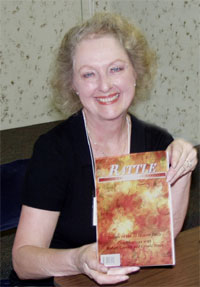 Stellasue's work has appeared in ONTHEBUS, Herman Review, On Target, Voices, Blood Pudding, The Cortland Review and many other publications. She is the author of many poetry collections, including three books, one of which Crossing the Double Yellow line was nominated for a Pulitzer. In addition to teaching and lecturing, Stellasue is the editor of the literary journal RATTLE, (www.rattle.com).