 It started with my aunt's heart. And after that, the snails. It started with my aunt's heart. And after that, the snails.
In about 1970, my aunt's heart had the cardiac equivalent of an Amtrak
wreck: a derailment, a mass of twisted wreckage, and something approaching
loss of life. Parts had to be manually disassembled and lifted out of
there. I was eight years old, and it was the first time I'd heard the
word "bypass." She went home from the hospital looking like
a tin can ripped open by a bowie knife. My mom, always ready to help
the sick and ill-starred, left our house to stay with my aunt for a few
weeks.
Mom came back changed.
My aunt, you see, had notions. Her husband was a world-famous grape-growing
expert, and they and my cousins had lived in mythical places like Malta
and India for months and years at a time. Their lives were about as far
removed from my family's suburban snoozefest as they could possibly be.
My cousins spoke dialects like I ate Big Hunk bars. And in her travels,
my aunt had picked up not only ideas; she'd picked up recipes.
One of her favorites was for escargot. Now, even though I was eight,
I knew that escargot had something to do with snails. But I always figured
they grew them on big snail farms in France. I pictured them looking
like the giant snail in "Dr. Dolittle" -- something you could
actually ride if you had the right kind of saddle, a top hat, and a British
accent. Somehow out of that snail, I imagined, came escargot. I didn't
dwell on the details.
When Mom came back from my aunt's, she had escargot on the brain. It's
simple, she said, stacking empty coffee cans on the counter. The average
California garden snail is perfect, she said, pawing through the pantry
and asking if I'd seen the cornmeal. She found it -- a little yellow
bag we hadn't used since the Johnson administration. She shook some cornmeal
into a coffee can, then into another, and then ferried the cans out to
the back yard, where she arranged them on their sides like little Quonset
huts among the pansies and candytuft. It looked like we were starting
a tiny air base out there.
The snails came. They came in twos, then in fours, then in great slick
mobs as word of the cornmeal got around. Mom trapped a dozen or so in
each can, fitted it with a ventilated lid, and fed the poor things all
the cornmeal they could stand. The cornmeal, she whispered, cleaned them
out. This was another detail I kind of didn't want to know. Then one
day I came home from school, and the cans were gone. Where were the pet
snails, I asked.
In the freezer, Mom said.
I don't remember eating the snails, but I suppose we did. What I do
remember is looking at Mom differently after that. She'd had some weird
hobbies, like hypnosis and handwriting analysis, but up to that point
none had involved freezing crustaceans.
One evening I got home after a tough day of playing with Breyer horses
and practicing my swearing, when I caught scent of something minty and
oddly familiar. I went to the kitchen and pulled the lid off a steaming
pot, and I knew I must be having a crazy dream. I pinched my arm, hoping
it wouldn't hurt and I'd wake up. It hurt. I pinched it again. It wasn't
a dream. Bobbing around in a pot of boiling water were twenty or thirty
cigarette butts, still faintly smooched with my mother's lipstick and
sporting their green brand name: Salem.
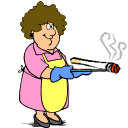
Mom walked in, a book under one arm. It's for the roses, she said, heading
off the question that sputtered in my mouth. Nicotine, she said, aphids
hate it. Kind of stinks up the place, she said, wandering off to the
far end of the house, leaving me in a cloud that smelled like Vicks Vap-O-Rub
on fire.
The aphid spray worked, sort of, but all those bloated cigarette butts
proved too nauseating even for Mom. Still, buoyed by the elegant, simple
success of her snails and cigarettes, my mom officially embarked on an
era of weird food. Over the next year we got a bellyful of froglegs,
live lobsters, oxtails, and beef-tallow fondue. Our neighbors loved this;
they had joke material for years.
Eventually my mom got bored with her experimental foods and turned her
energies back to being a world-class bridge player, which was her real
calling. But we never lived it down -- the snails and the frogs and the
cigarettes. In straight-edged suburbia, we were the slightly daft neighbors,
the ones with nine cats and a pea-green microbus and, occasionally, a
strange smell floating out our windows. Our neighbors knew better than
to think it was an emergency -- a chemical spill or a botched suicide.
Still, I imagine they did a quick head-count of their own households
-- pets, children; check -- just to be on the safe side. And then some
joker would bribe another to call us up and ask the magic question: "What’s
for dinner?"
And they'd hope for the best: a batch of prairie dogs this time, or
maybe carburetor stew.
Amy Miller is kind to snails in Burlingame, CA. She can be reached at amymca@earthlink.net |
