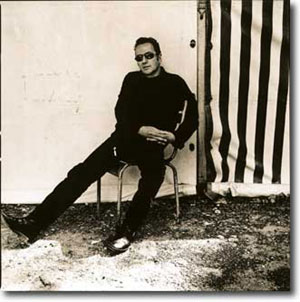
One of my heroes, Joe Strummer, died on December 22nd of last year. He
was 50.
Joe was lead singer and co-songwriter (with Mick Jones) for the Clash
-- a group billed, at their zenith, as "the only band that matters."
And to me, back in the early '80s, they were just that.
Sometime last year, I got a hankering for the Clash. Some song was lodged
in my brain -- "Janie Jones" or "Career Opportunities."
So I dug out an old bootleg cassette with their first two albums, popped
it in the car stereo -- and played it for weeks, over and over, crash
and clang, "Drug-Stabbing Time" and "White Riot" and
"Jail Guitar Doors." I drove around, laughing my head off, shouting,
"These guys were great."
I got hooked on the Clash twenty-some-odd years ago, when I had my first
job as a secretary at a defense-industry magazine. Our sleek journal glorified
Sidewinder missiles and needle-nosed fighter jets. My boss patted me on
the butt a lot and made jokes about "nooners." It was the dawn
of the Reagan era: The hawks were squawking at the Soviet Union, which
looked like an awfully big country to be pissing off. I spent my days
transcribing interviews with people like Edward Teller, the father of
the hydrogen bomb. I was beginning to get a feeling that something screwy
was going on: A few Americans had an obscene amount of money while the
rest of the world went barefoot. I was eighteen. I was dissatisfied, but
I wasn't sure why. And along came the Clash.
I bought "London Calling" because Rolling Stone had already
dubbed it one of the greatest albums of all time when it was released.
Something about the cover -- Paul Simonon, in silhouette, about to smash
his bass against a smoky stage -- got my blood up. What did my butt-patting
boss know about smashing basses? It was just what I needed: the dirty
book in the desk drawer; the cherry bomb in the Corporate toilet. And
there was Joe Strummer, telling me
The men at the factory are old and cunning
You don't owe nothing, so boy get runnin'
It's the best years of your life they want to steal.
It rang like a bell -- crystal clear, perfectly sensible. Man, was he
right.
Did I storm the Institution? Did I throw off the chains of the slavering
corporation? Not really. I quit the job. I dropped out of the corporate
world, put in some time on a horse ranch, got through a few years of college
on very little money. I was the rebel without a bank account. I made friends.
I danced a lot. I smoked clove cigarettes and wore gray and black. And
I went on loving the Clash.
Eventually, the band got older and broke up, brought down by the pitfalls
inherent in adult relationships: backbiting, control issues, warring visions.
By 1984 they'd fractured into two bands, with Joe and Mick fighting like
a couple of divorced relatives. For a while, you couldn't be in a room
with the two of them. Years later they reconciled enough to collaborate
on a few projects, but the glimmer was gone. And now Joe is gone too,
felled by a heart attack after walking his dogs.
But he planted a kernel way back when. It goes like this: If you think
there's something wrong, there probably is. If you find yourself driving
along one day, yelling, "All the power's in the hands / of people
rich enough to buy it / while we walk the street / too chicken to even
try it," sneering a little -- even at age forty -- it's a good thing.
It's a reminder that you have a voice. Joe had a microphone, and that
made the difference. But he started with his voice, just like any one
of us.
It's no accident that the Clash appeals to me all over again now. Sinister
politics and saber rattling are on the rise. We're sliding toward a war
that doesn't look like it will do anyone any good, except for the arms
dealers and those in power -- who stole the damned election in the first
place. And here's Joe again, in all his recorded glory, telling me it's
OK to feel that way. Better yet, he says, sing it. Shout it. Tell those
imperialists to go f**k themselves.
So it's me and Joe in the car again, singing like the world is depending
on us -- like everyone, everywhere, can hear us. Our voices are small
in a very large world, but we know what to sing. And like he says, the
song is an old rebel one.
Rebel Waltz
I slept and I dreamed of a time long ago.
I saw an army of rebels, dancing on air.
I dreamed as I slept, I could see the campfires,
a song of the battle
that was born in the flames,
and the rebels were waltzing on air.
I danced with a girl to the tune of a waltz
that was written to be danced on the battlefield.
I danced to the tune of a voice of a girl,
a voice that called
"Stand till we fall --
We stand till all the boys fall."
As we danced came the news that the war was not won.
Five armies were coming, with carriage and gun.
Through the heart of the camp
swept the news from the front.
A cloud crossed the moon,
a child cried for food.
We knew the war could not be won.
So we danced with a rifle, to the rhythm of the gun.
In a glade through the trees I saw my only one.
Then the earth seemed to rise, hell hot as the sun.
The soldiers were dying,
there was a tune to the sighing.
The song was an old rebel one.
As the smoke of our hopes rose high from the field,
My eyes played tricks through the moon and the trees.
I slept as I dreamt I saw the army rise.
A voice began to call,
"Stand till you fall."
The tune was an old rebel one.
The Clash / from "Sandinista!"
Amy Miller (amymca@earthlink.net)
is well on her way to being an old leftie in Burlingame, CA.
|
