|
|
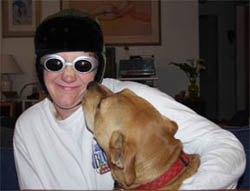
| Renee and Lionel - (sort of) her dog. |
Welcome to another edition of "Foolish Adventures." Please
spit out your gum, and keep your hands and feet inside the car at all
times. Thank you.
Welcome to another edition of "Foolish Adventures." Please
spit out your gum, and keep your hands and feet inside the car at all
times. Thank you.
The excitement started with boarding a train for Warsaw, or Warszawa
(Vorshava) as you have to say it when you buy train tickets or they send
you to Yalta for being a tourist. The train is marked on the outside
in big red letters with the name of Poland's national train company,
WARS. Before I go on, I should tell you that buying a train ticket in
Russia is challenging. Mostly because, the women who sell the train tickets
sit behind these little windows that have tiny doors set beneath them
the way a cashiers' window has a little hole you can talk through. The
difference being, these women can close and lock these doors any time-
if they are busy, or don't want to talk to you, which if you are American
and carrying a large backpack means all the time. Fortunately we got
help from a Russian woman who knew the correct procedure, which is to
step in front of whoever is waiting for the magic door to open, pound
on the window and yell, "any seats for Warszawa next train?" in
Russian of course. At which point they sigh and look extremely annoyed
and sell you a ticket. OK I just had to tell you about that. Diversion
diverted. So you are getting on the train. It's best to get on the train
in the day, unlike what we did, because the electricity on the trains
doesn't work so you have to feel your way to your compartment, especially
if you are an idiot tourist who has never done this before, wearing a
large backpack bigger than the aisle to the door, which constantly catches
on every door handle you go by, this is not so easy. Luckily once we
got inside the compartment I found I had my trusty dusty tiny flashlight
keychain, thankyou whoever gave that to me, it saved us on the train--
especially in the dark little bathrooms, where it was apparent that not
everyone had a flashlight. The rest of the train ride was generally traumatic,
although the beds were comfy enough. I will only relate two more train
things - that breakfast was a foil wrapped pastry called "7 days
mini croissant" which came only in "champagne" flavor
- the oddest thing I have tasted on this trip. And, of course, Byelorussia.
Once we got to the border at Brest (Yes, that's pronounced Brest) some
men with uniforms and pancake-shaped black brimmed caps came on board
and asked for our passports. We gave them over. They came back a few
minutes later and asked for our visas. We handed them our hard-won Russian
visas (which we never saw again) and they left. Then they came back again
with a new guy in a different uniform with a bigger pancake who told
us to pack up our stuff and follow him. This was bad. What commenced
was a three hour tour into bureaucratic hell, punctuated by the only
English word Byelorussian border officials know - "Prob-Lem!" We
spent a lot of time in a communist-era waiting room in the company of
a pacing woman who had obviously been crying. It turned out, you must
have a Byelorussian "transit visa" to travel across the country
(which is between Russia and Poland) which we did not know about. When
we didn't have it they told us we must take another train back to Moscow,
get one, and then come back. They kept insisting on this, right up until
the point when I handed them a not inconsiderable sum, in crisp American
dollars. Then, suddenly everything started moving extremely fast, customs
was a breeze, every official was our friend, they personally showed us
to our seats on the train (which had somehow waited for us,) and we (our
hearts still pounding uneasily) went our merry way. Phew. My very first
bribe. Aside from that the train ride was rather glum, as you can imagine.
I don't remember much about the scenery except there were a lot of goats.
 Fortunately, once we arrived in Warsaw there was almost immediately
a train for Krakow, and once we arrived in Krakow, everything suddenly
became easy. The hotel was clean and comfortable, and we spent three
days wandering around, looking at all the art galleries and some of the
museums (for some reason most of the museums have hours like, 10-3 on
tuesdays and thursdays) Krakow has a big "historic" center
which is a manic conglomeration of Oooooooold stuff with, McDonalds,
antiques, teen fashion, and swarms and hordes and clots of tourists like
us. It was good to see some familiar faces, if only archetypically so.
Krakow is also BRIMMING with accordionists! You can only imagine the
joy, the delight, and the utter lightness I felt when I saw people walking
around, with an accordion casually slung over one shoulder! Little children
with little accordions slung over one little shoulder! True, not all
of them were very good accordionists, like the guy who showed up EVERY
DAY and played the same song ALL DAY LONG!-With flourishes. But a couple
of the guys out there are real geniuses. The old town has a very large
square in the middle, the largest medieval square in Europe according
to the guide books, the buildings are all lit up and a trumpet plays
from the highest steeple every hour, and it's very fun to wander around
at night and get lost and keep coming back to the same damn square you
just left a minute ago and don't you recognize that bar, I think, or
was it the red one? Overall Krakow was a great antidote to Byelorussia. Fortunately, once we arrived in Warsaw there was almost immediately
a train for Krakow, and once we arrived in Krakow, everything suddenly
became easy. The hotel was clean and comfortable, and we spent three
days wandering around, looking at all the art galleries and some of the
museums (for some reason most of the museums have hours like, 10-3 on
tuesdays and thursdays) Krakow has a big "historic" center
which is a manic conglomeration of Oooooooold stuff with, McDonalds,
antiques, teen fashion, and swarms and hordes and clots of tourists like
us. It was good to see some familiar faces, if only archetypically so.
Krakow is also BRIMMING with accordionists! You can only imagine the
joy, the delight, and the utter lightness I felt when I saw people walking
around, with an accordion casually slung over one shoulder! Little children
with little accordions slung over one little shoulder! True, not all
of them were very good accordionists, like the guy who showed up EVERY
DAY and played the same song ALL DAY LONG!-With flourishes. But a couple
of the guys out there are real geniuses. The old town has a very large
square in the middle, the largest medieval square in Europe according
to the guide books, the buildings are all lit up and a trumpet plays
from the highest steeple every hour, and it's very fun to wander around
at night and get lost and keep coming back to the same damn square you
just left a minute ago and don't you recognize that bar, I think, or
was it the red one? Overall Krakow was a great antidote to Byelorussia.
One of the days I went to visit Auschwitz, which is not far from Krakow
in a town called Oswiecim (that was actually the name before the Nazis
took over and renamed it Auschwitz, now just the remains of the concentration
camps are called Auschwitz.) Actually the number of camps around Poland
is astonishing, only a few have been kept as memorials compared to the
number that were operating 1940-45. There are two main camps in Oswiecim,
Auschwitz I and Birkenau- Auschwitz II. Birkenau was an enormous death
machine, train tracks right down the middle for dropping people off,
rows upon rows of barracks, four large crematoria (which were all dynamited
when the Nazis fled.) Auschwitz I is relatively small and contained,
and nowadays without all the electrified barbed wire looks almost like
a wierd village, with its rows of three story brick buildings and tree
lined walkways. There is one gas chamber and crematorium and a gallows,
and a wall where they used to take people to shoot them. Now it just
looks like a crumbling brick wall, apart from the flowers people have
brought to remember the dead. Inside the buildings they have exhibits,
some of which are very sad like all the hair they found when the Soviet
army freed Auschwitz, there were bales and bales of hair which were usually
sent to Germany and made into cloth, this was just whatever was left
when the Germans fled - It fills a space about 150 ft2. Also, there are
rooms and rooms of shoes. You think you are done with the shoes, you
get to the next room, there's more shoes. In those days I guess people
used to put little horseshoe-like metal attachments on their heels, I
saw several of the shoes had them. One of the displays is of family photographs
that people brought with them when they came, they thought they were
being relocated so they brought all their best stuff. Someone actually
went through, and researched all the families in the photographs so they
could tell their story. Most of the people in the photographs were killed
in the camps, whole extended families, maybe one person lived. It made
it more personal. When I was wandering out where the old storehouses
for the people's stuff use to be, I was taking photographs and I dropped
something. When I leaned over to pick it up I saw the ground was covered
with buttons. I picked up one button, a white pearly button. I felt it
between my fingers and thought about taking it home with me. A button
that was worn by someone who was killed in the camps. I put it back down
and walked away in the direction of the piles of ash that used to be
people.
OK enough. I am now in Zakopane, a mountain town near the Slovakian
border, the air is extremely pleasant and tomorrow, hiking.
Send your comments to Renee email Renee@hazelst.com
|
