|
May '03
by JoAnne Henderson
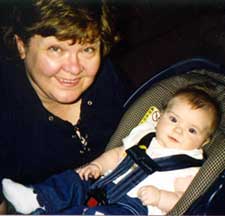
This is me with my granddaughter Jaclyn, five months old. I volunteered
to be her Friday babysitter while my daughter worked, and what a blessing
that turned out to be. No matter how pressured I got with my college
classes, I could count on those Friday hours with Jaclyn to take me
away from the grind. Those little hands, that precious smile. I'll stop
now; the first-time grandmother in me is leaking.
I took an advanced fiction writing workshop this semester, taught by
a Pulitzer Prize-winning poet, Stephen Dunn, --not the least bit intimidating.
Each week we read two short stories by noted authors, and then to flex
our writing muscles we wrote a single page in the style of one of them.
It was fun, while looking for our own style, to "try on" the
styles of other writers. Here's an excerpt from a piece I wrote after
reading "The Lesson" by Toni Cade Bambera.
Back in my high school years in the fiery late-60s, in the days of
short skirts, pale lipstick and ratted hair, when nobody over thirty
could be trusted, I had a French teacher named Madame Moak. Not Mrs.
Moak, but Madame, en francais, s'il vous plait, and the same thing in
class, no English. Nobody dared. Now the funny thing was that she was
hard as nails for sure, but she looked entirely different. Her hair
was some bottled shade of red, but you just knew hers came from a beauty
salon and not a Clairol box from Drug Fair like your mother's. She was
a short woman, a bit pudgy, but her nails and makeup were perfect. She
wore skirts and dresses, as did all the lady teachers back then, but
she wore them with color-coordinated three-inch heels that made her
face look like her feet hurt. The way her body tilted forward and she
used her forearms for balance, hands dangling, and the way she lifted
each foot and put it down just so, she looked like a flamingo walking.
Imagine the challenge, as a new writer, of imitating John Updike, Raymond
Carver, Pam Houston, Susan Minot, even Poe and Chekhov. I think it's
a great technique to encourage new writers to try different styles and
play around with their imaginations.
One of my favorite assignments was the first one, an ice-breaker that
gave us a peek at each other's writing in a way that was playful. We
were simply told to go home and write a two-page fictitious scene that
included a famous person, a breakfast cereal, a composer, a venereal
disease, and the word "metatarsus." The next class was a blast,
reading those scenes outloud and laughing. The exercise not only helped
us get to know each other, but it got us over the hump of reading our
first piece aloud in class. We knew we were in a safe place.
Hey, Hazel Street is a safe place for me, too, and I feel like reliving
that moment. Let me share with you the piece I wrote.
Billy rubbed his short-cropped head, stroked his salt-and-pepper beard,
and then crumpled up another sheet of paper and tossed it. Rejected
ideas were piled up on the floor like a child's stash of snowballs.
The Grammy awards that rested on chrome and glass shelves to his left
annoyed him.
"Billy Fucking Joel, hot shot songwriter, awards up the yin-yang,
and I can't write a goddamn verse," Billy said.
"Now, Bill, calm down. You'll come up with something. You're
a genius and you know it," said his agent, who lay sprawled on
the black leather sofa.
"Jack, you don't know jack-shit. You don't know what I go through
to write this crap, and you don't care, as long as I can sign my name
on your check."
Jack sat up. "I think your blood sugar is out of whack, Billy.
What say I bring you a bowl of cereal? Shredded wheat with skim milk,
right?"
Billy nodded and played absent-mindedly with the keys, thinking about
"Piano Man." It had been easy to write, but it was boring
pap; and he got a migraine thinking about all the times he'd been asked,
"What is a real estate novelist anyway?"
Billy had watched his career spiral downward, and now he was trying
to come up with songs commissioned by special interest groups. He detested
the work. How could a man respect himself when he was reduced to writing
for a chain of large-size shoe stores? The refrain on that one made
him groan: "Charlie was a big man on campus, as the old saying
goes, with feel so long that his metatarsus couldn't reach his toes."
His old buddy Elton John was now refusing to be seen with him on stage.
Thinking about that frustrated Billy further. He knew Elton had written
"The Last Song" about a young man whose body was deteriorating
from AIDS.
I can't believe you love me,
I never thought you'd come,
I guess I misjudged love
between a father and his son.
Billy thought the lyrics were stunning, that the story was told clearly
without the syndrome being mentioned. And what did you write for Pfizer
Drugs, you jerk? Billy asked himself.
Do you remember syphilis
when it was ubiquitous?
They counted deaths on an abacus
until penicillin saved the day.
No wonder your fans have abandoned you.
When Jack returned to the room with breakfast on a tray, looking like
a has-been butler, Billy was playing Mozart and considering a career
change.
In case you're wondering, I am very serious about taking these courses
and improving my writing. Who says a writing student can't have a little
fun along the way?
|
