
"Forget about it" |
FOUR POETS LAUREATE
by JoAnne Henderson
09/23/02
On September 21st, I had the great pleasure of attending one day of
the four-day Geraldine R. Dodge Poetry Festival 2002 in Stanhope NJ.
Hearing poems read by Edward Hirsch, Li-Young Lee and Grace Paley was
worth the ticket price. As a bonus, I listened to four US Poets Laureate
reflect on the office.
When Rita Dove got the phone call offering her the position, she thought,
"It will ruin my life but I'd be crazy not to accept it." In fact, being
Poet Laureate did ruin her writing life for several years. Ms. Dove
had no idea what the office would be like, so she decided to do what
needed to be done and "they'd stop me when the money ran out." Her goal
was to bring poetry wherever she could, and she brought it to the US
Naval Academy, to Sesame Street, to church basements. Ms. Dove read
poetry in schools and in one minute public service announcements on
cable TV. She went to lunch with members of Congress to find out what
was happening in their home states. Often they wouldn't know, but then
they'd go home and do something.
When Robert Hass' phone rang, he thought, "I'm being asked to be class
monitor!" He saw himself having to attend "lots of receptions where
there would be little cubes of cheddar cheese with toothpicks."
Hass pointed out that the position was once called Consultant in Poetry
to the Librarian of Congress. Senator Spark Matsunaga of Hawaii lobbied
over twenty years for the term "Poet Laureate." In 1985, Congress finally
changed the office's title to "Poet Laureate Consultant in Poetry."
According to Hass, the first person called US Poet Laureate was Robert
Penn Warren, who took the small stipend and never showed up in Washington,
DC. Instead, he stayed home and wrote All the Kings Men.
The US Poet Laureate is an apparently autocratic appointment by the
Librarian of Congress. It was an office that was scarcely noticed, Hass
said, until a Russian Librarian of Congress named a Russian poet, Joseph
Brodsky, in 1991.
That got the attention of the press. Now five minutes after accepting
the position, a new Poet Laureate is handling calls from The New York
Times and "The Today Show." Hass said it was front page news in San
Francisco that a local poet had been named Poet Laureate. He felt like
he was inside a bubble where "all the attention in the world was on
me." He even got letters addressed to Robert Frost.
Robert Pinsky stressed the ambivalence that many Poets Laureate feel
about the position. In the first place, he sees the old title "Consultant
in Poetry" to the Librarian of Congress as a more noble title, one that
reflects service to the people. "'Laureate' is more royal sounding and
Americans are suckers for that," he says. "'Laureate' has cachet, but
it also sounds like you're serving an elite group." To Pinsky, Poet
Laureate has become a job where you're "sort of trying to constantly
create culture with a small stipend, no staff, and a tiny travel budget."
He'd rather see it be a literary honor, where Poets Laureate didn't
have to be "hucksters for poetry" unless they chose to be.
 |
When
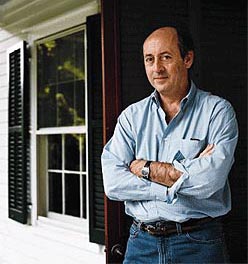
the current US Poet Laureate, Billy Collins, received his phone call,
he was told, "You're the Poet Laureate." This led him to believe that
the Librarian of Congress had called five other people who had said no,
and he wasn't being given the option of declining. (T. S. Eliot, in fact,
turned the position down.)
Collins said that a friend commented that the odds of his "being named
Poet Laureate were like the chances of a Chia pet winning the Preakness!"
Collins suggested that the whole thing was a "government plot to take
one poet out of commission, by making him so busy he can't write." He
spoke of receiving bizarre mail, particularly from "people with delusions
of grandeur -- either about their own poetry or their children's."
American culture has become more open to poetry in recent years. Rita
Dove was on Sesame Street and Lifetime, and Robert Hass did a syndicated
newspaper column for years. Robert Pinsky read poems on "The News Hour,"
and got enough responses to his Favorite Poem Project to fill two books.
Billy Collins observes that radio, especially NPR, is a perfect medium
for poetry. "Radio can ambush you with a poem. You're riding in a car
or making an omelet, and a poem pops up. It puts poetry in the stream
of everyday life."
One audience member asked if Poets Laureate felt pressured by the press
to respond to major events. Pinsky, who was the past Poet Laureate on
September 11th, 2001, responded that he made up a kit of five or six
poems already in existence to give to reporters, and fairly soon new
poetry about 9/11 was being written. Pinsky did not feel pressured by
the press; rather, he liked answering the question, "What does poetry
say about this?"
A frivolous moment was spent discussing what to call a group of Poets
Laureate, such as the one currently gathered. Hass suggested a "strophe
of Laureates." "A gaggle of Laureates," Collins offered. Pinsky's "laundromat
of Laureates" drew chuckles from the crowd.
More laughter followed when Billy Collins, who had said earlier that
the next Poet Laureate should be a woman, reversed gears. In England,
Poet Laureate used to be a lifetime post. "We should make ours a lifetime
appointment," he said. "Starting now."
|
